Kit
There were several reasons I undertook this tour. In addition to visiting Portsmouth, I also wanted to explore how I would cope with a multi-day camping tour, and it was a shakedown tour for the kit I’m going to need on longer tours next year. In this section I thought I’d share my reflections on what kit worked, what didn’t, what I ought to have taken, and what I could have left behind.
Tent
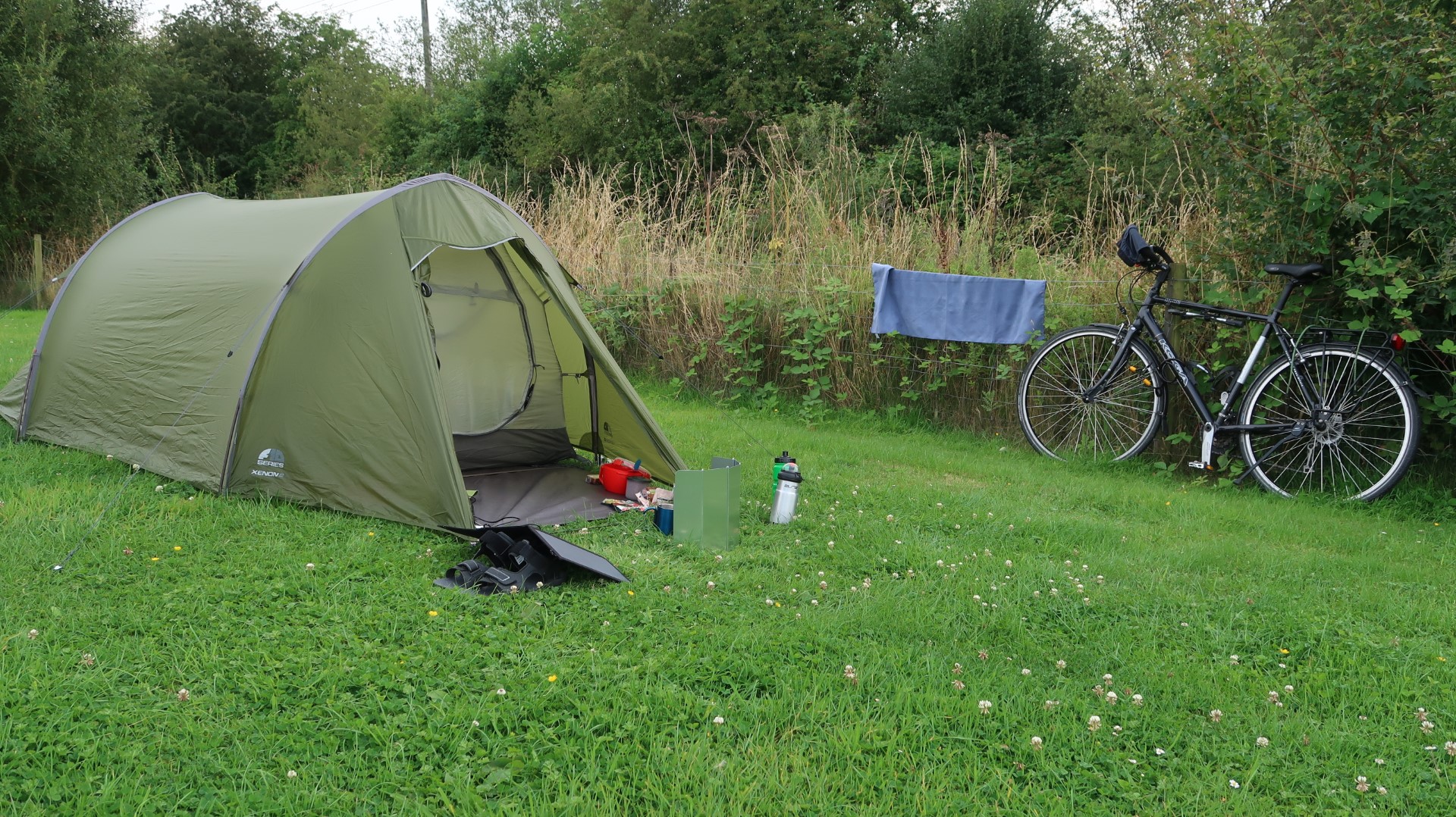
The Force Ten Xenon UL2 I took on this trip replaced the Vango Tornado I used previously. It’s about half the weight and packs down to about half the size of the Tornado. I reviewed it in detail in this video (apologies for the poor audio):
Having now pitched and struck it daily over the tour I can say they proved largely painless processes. The wide-mouthed stuff sac was really useful when packing away, and it also held my Thermarest Trekker seat (Which I didn’t use and which therefore begs the question will I need it on this kind of tour in the future?).
It was absolutely fine in the wind and rain, although the flysheet – like all silnylon shelters – did sag. Retightening the guys only addressed this partially and temporarily. The fly even sags somewhat due to condensation, then sometimes touches the inner and if something is touching that, it will become damp … like the footbed of my sleeping bag. On still, cold nights with high humidity, condensation was really bad. But without a breeze, I can’t ever see flow-though of air being adequate, whatever the tent design.
I was a little worried that the porch space might not be adequate, but I never had to put it to the test and clutter it up with wet panniers etc, so that remains a concern. Nonetheless I was generally happy with and had confidence in the performance of the Xenon.
Sleeping
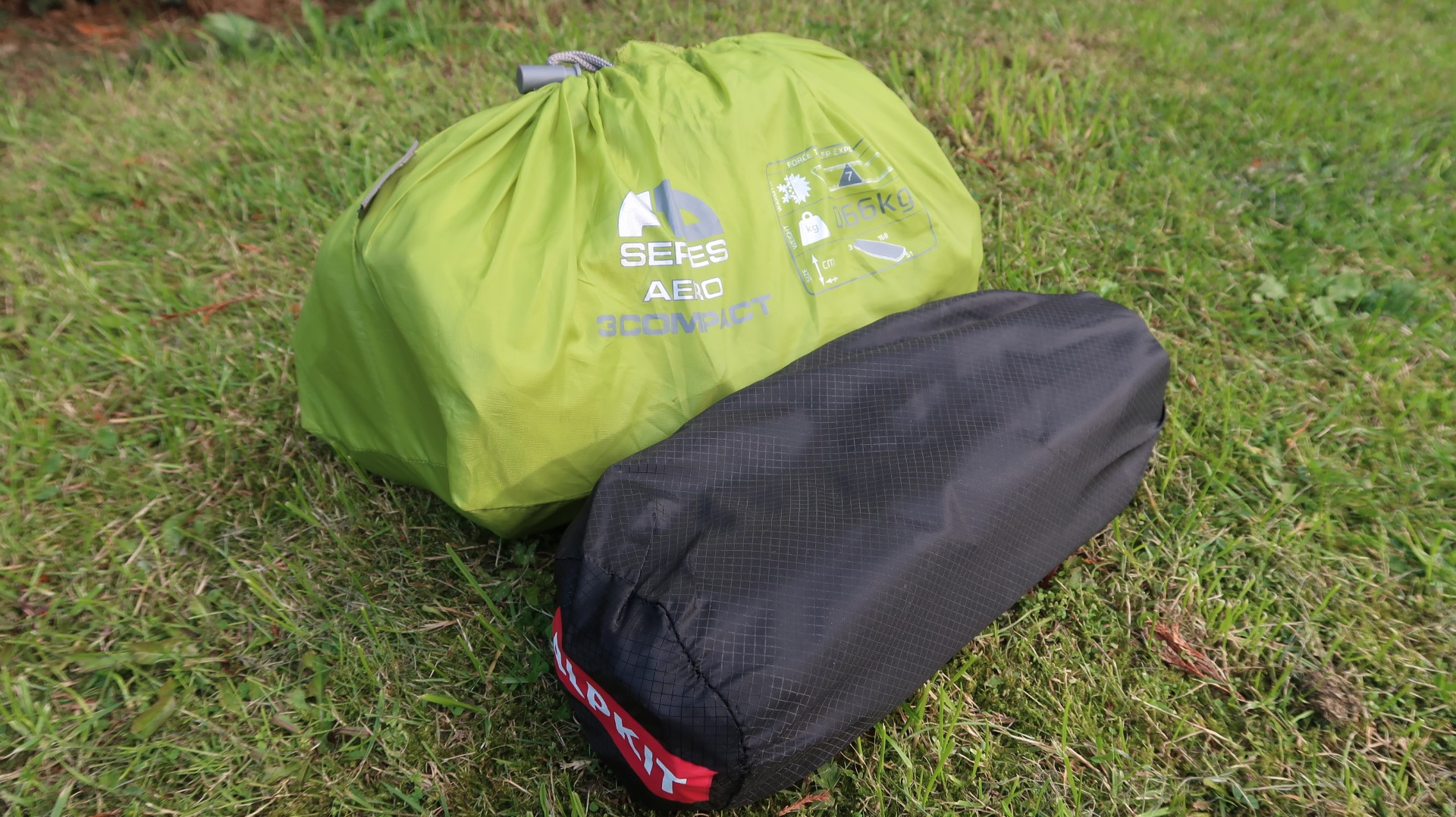
I was very happy with the sleeping bag, a Vango Venom 300, although as I mentioned in one of the earlier posts, it might have been slightly too much bag for the conditions. I was just a little too toasty occasionally, but that’s much easier to remedy than being too cold. I used a silk sleeping bag liner which was generally fine, but …! The problem was that it had a pillow ‘hood’ and this caused a real problem, affecting the quality of my sleep most nights. When I turned over in my sleep, the liner near my feet would turn with my body and the hood with pillow tried to follow, subsequently needing correcting … often! The pillow, a Vango Ergo inflatable really was great. The liner was too, but putting them together was a problem. On returning I’ve discovered some people strap their pillow to their sleep mat using a t-shirt or buff; maybe I’ll give that a shot? Talking about the sleeping mat, I was impressed with the performance of the Force Ten Aero 3 I bought. It self-inflated well, needing only a single puff of breath (Yeah I know. Breath = moisture = bad, but weighed against having a may which is not firm enough, well I know where the balance falls for me). It was thick enough to be comfortable whether back or side sleeping, and kept me insulated from the ground, although to be fair it was rarely cold enough to push the mat to its limit. The problem though was just its bulk. The 0.66kg I could live with, but it took up almost the same space as the sleeping bag. I’ve also bought a non-self-inflating Alpkit Numo, which as you can see takes up much less space (it’s even smaller than the photo shows) and weighs only just over half that of the Aero. It of course has its downsides, not least the effort needed to fully inflate it. I’m struggling to resolve this, but when I travel abroad next year, I suspect the main factor will become saving space.
Cooking

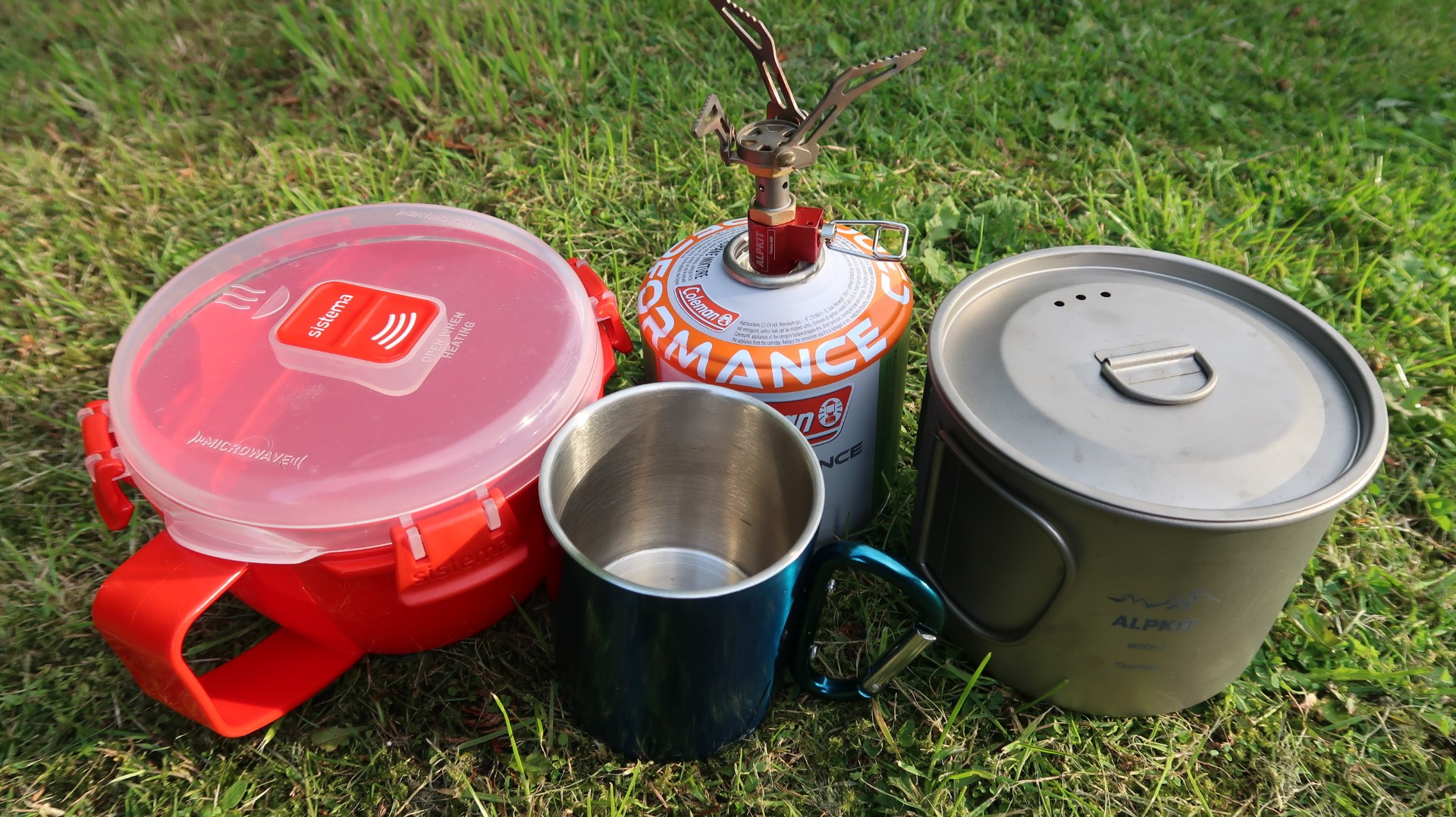
I decided early on to go for a minimalist setup and although I love cooking at home, I tend to opt for a lower demand approach when touring. So my only need would be to heat water, whether for a brew or for meals which could be either rehydrated (e.g. couscous) or warmed in the bag in boiling water. Here in the UK I figured I wouldn’t struggle finding food. To provide for those needs I have an Alpkit 900ml MyTi Pot which is heated by a tiny AlpKit Kraku stove which sits atop a standard 250g gas cartridge. The twin-walled mug was great at keeping coffee hot without burning my lips and the plastic pot did a good job of keeping food (like porridge) warm whilst it cooked after having boiling water added. Apart from the mug, the other items fitted together reasonably well, the gas in the MyTi Pot which sat inside the plastic pot.
I was happy with this setup, but although the gas is more convenient and cleaner than liquid or solid fuel burners, it bothers me for a couple of reasons. Firstly it’s expensive – I might have found a partial solution to that problem with a gas cartridge adapter which accommodates the longitudinal aerosol-type canisters which are much cheaper. Secondly, you never know when the damn thing’s going to empty! Having done ten days away, do I dare risk this same canister on another tour? Sure I could carry a spare, but then we’re back to the space it would take up (maybe my two-pannier strategy needs a rethink?).
Electronica
Generally the 20000 mAh RavPower battery pack I had was up to the job and I was able to keep topping it up. The Anker PowerPort solar panels weren’t capable of achieving this alone however. Clearly I couldn’t have them out in the rain, but on a couple of occasions had them strapped over the tent on my rack. Just based on the LED indicators, I estimate that after around eight hours on a moderately sunny day, the battery pack charged by about a third to a half of its capacity. A couple of overcast or rainy days and that figure would be reduced markedly.
It then becomes a question of whether it’s possible to access mains charging to supplement solar, but here it becomes a matter of time and access. Firstly can you get somewhere to charge your pack. Sure an increasing number of places like coffee bars offer such a thing, but it’s whether you can afford to sit around long enough to get the charge you need. Using low capacity devices then becomes a helpful strategy and one of the reasons I chose to take my 7” rather than 10” tablet for journaling. Running the Garmin also requires less juice than using a smartphone for navigating would do … I think! I need to develop further experience with these factors; maybe I might have to think about finding accommodation every so often where I can charge overnight?
One device which remained in its bag the whole tour was my mp3 player. Podcasts are my thing rather than music and I love listening to podcasts whilst on local rides. Despite sometimes long hours in the saddle, I never felt the need for entertainment other than that provided by the environments within which I found myself and in the evenings, journaling pretty much sucked up much of my time. Oh, and I only made use of the Kindle on a couple of occasions. Once again though, I wouldn’t be without either on a longer tour; you never know when you might get stuck waiting somewhere and be in need of a suitable distraction.
Navigation
Following the gpx routes I’d pre-installed on my Garmin Touring Edge worked out just fine. The device seemed to store enough charge for a day’s cycling, although I never pushed it beyond about eight hours. I guess if that became necessary, I could hook it up to the battery pack and continue navigating.
The two areas where I found it fell short were if I needed to get an overview by zooming out, detail was inevitably lost. The small screen is a real problem here. Zooming in and using the touch screen to scroll around was an absolute pain as it was so easy to catch one of the on-screen buttons and suddenly be catapulted off elsewhere. Its other shortcoming arose when I was trying to get it to navigate to a point. It was frustratingly slow in performing a search for a location, I still haven’t resolved how to quickly find POIs that I’ve downloaded to the device and subsequently use them to navigate. I’m also not convinced that on-device route finding suits my needs.
None of the above was a particular concern on a largely pre-planned route, but in the future I’d like to be more confident that on a longer tour where advanced planning might be less possible, I can make changes on the fly. Maybe I have to do this in another app (e.g. maps.me on my tablet)? I hoped to be able to get away without paper maps completely, but I’m now having a rethink, especially for areas which are somewhat more remote/less familiar.
Clothing
Two merino t-shirts and two pairs of (hiking, quick-dry) shorts seemed to work just fine, although laundry became a pain – not enough to warrant a load for a machine. Was impressed with the quick-dry, ultralight unmentionables; I had four pairs but washed each day’s whilst showering and they (mostly) dried overnight. I didn’t use the pair of long trousers, socks or my lightweight down jacket, but I wouldn’t travel without them. The trousers have zip off legs and consequently provide a backup pair of shorts. All together might be needed if the temperature nose-dived or protection from biting things became needed.
I’ve rarely found the need for waterproof leggings; wet legs tend to be easier to dry than wet legwear. I guess if I was likely to experience cold rain, I might review that. I did take a hand-sized portable umbrella, figuring it might be better than having to don my waterproof top in the event of needing the ‘facilities’ at night or moving around the campsite during rain, but it never got used. Still on the fence with this one.
Bike
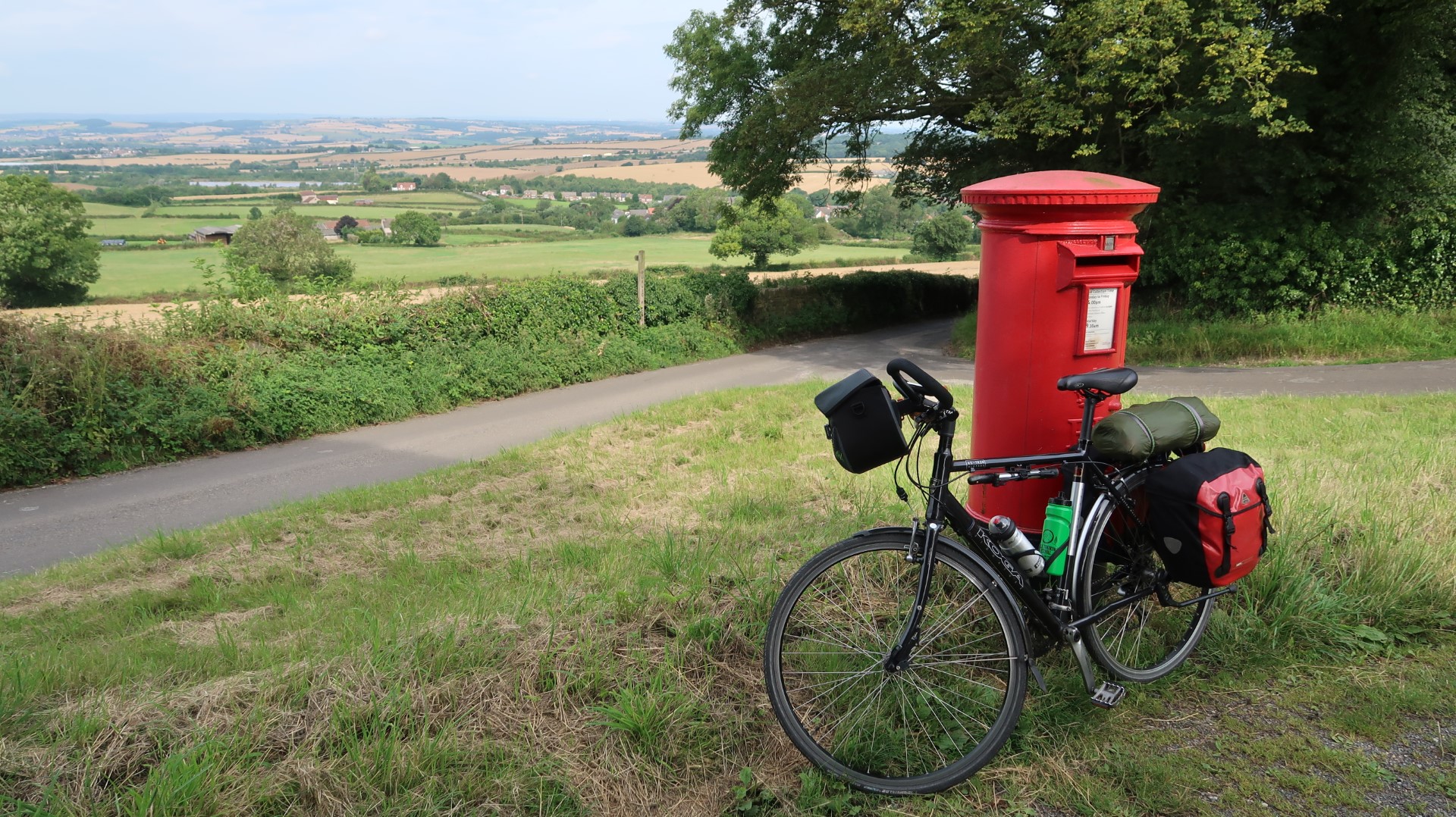
Maybe last, but definitely not least. There’s no decision to be made here. ‘Bogtrotter’ my Koga Miyata Signature has served me well over a number of tours since our ‘End to End’ over ten years ago. It’s proven reliable and robust and I never worry that it might not be up to the job. On this tour I was blessed once more with no mechanicals, not even a puncture. Although the current Schwalbe Marathons tyres are in reasonable shape, before my international jaunt in the new year I plan to replace them with a pair of Marathon Pluses. The chain’s also sufficiently worn to warrant a replacement, together with a new cassette. What it does need though is a replacement bell. I took off the one which came with the bike at some point and am looking for a replacement, but I’m struggling to find what I want – a ‘ring-ring’ rather than ‘ping’ bell. I have the former on my Elephant Bike and I think it just sounds more friendly towards pedestrians, so I’ll keep looking.
As a shakedown tour this certainly brought to the fore some things I’ve been contemplating for next year. I got some answers to questions I already had, and a few questions I’d not considered emerged. Into the bargain, I got to see Portsmouth and a few more slivers of this green and pleasant land. In total my accommodation for ten days cost £92.65 and food added a further £128.60. Entry into Portsmouth’s Historic Dockyards was £31 and two return train fares was another £10. I reckon that’s close to a bargain. What’s not to love?