Came across an interesting post on the CycleChat forum yesterday, by a Masters student conducting research into cyclists on trains for ScotRail. I completed the survey as I invariably do, knowing how difficult it can sometimes be for researchers to gather data. And train travel and bikes is a topic near to my heart. You only need to take a quick run through my tour journals where the trials and tribulations of taking your bike on a train quickly become apparent. The questions in the survey were brief and mainly in multiple choice format, so left little opportunity for expanding points, so I thought I’d try and draw some of my experiences together in a slightly longer response.
It’s important to set out from the start that different cyclists have different needs as far as train travel is concerned. For example it will depend on whether you’re a commuter or tourer, whether you’re on a folder or tandem, whether your journey is short or long, and perhaps crucially, which train operating company (TOC) you’re obliged to use. The comments which follow will therefore speak to my experiences which fall largely into two categories:
As a cycle tourer where I need to use trains to reach a part of the country it would either be difficult to get to otherwise, or logistically difficult to take a car.
For day trips where I’ll take a train out to a start point and ride home from there. This widens the area within which I can easily cycle and opens up new roads and lanes. I like ‘the way less trod.’
I should also say that I love travelling by train and will consequently put up with a degree of inconvenience (such as rail stations not being where you need them), expense (although choose tickets wisely and it can be cheaper than car travel), and poor service (trains being cancelled).
Let’s begin with a positive. You don’t have to pay extra to take your bike on a train in the UK; it’s free. (Sidenote: unless you want to travel by Eurostar across to the continent, in which case you are likely to have to stump up a few quid). If you take your bike on a plane, unless you can finesse your baggage allowance, you’re going to have to pay a fee for the bike. You’re even charged a fee for transporting your bike on some ferries, both small and large. So that’s one up for the train.
I wonder though whether ‘free’ is always a good thing and in the case of bikes on trains, whether it allows the TOCs to enable bike travel as an afterthought. If cyclists had to pay for their bike to travel, might that then oblige TOCs to provide a particular standard of service or accommodation?
In recent years, as our awareness of and concern for climate change has grown, pressure to use less polluting forms of transport has grown. Mass transit such as trains (and buses), and self-propelled forms of travel – bikes – have risen up (some) politicians’ agendas as they seek to encourage travel in which less CO2 is emitted. As a consequence, it is now common to find TOCs will refer to cycle travel in their policies and practices. I wondered though how serious they were and decided to survey a small sample of TOCs to see how they cater for the needs of cyclists. The ones I chose were Northern Rail (the local operator), ScotRail (as addressed in the CycleChat forum post), Cross Country and TransPennine Express (both of which also serve Sheffield, my local mainline station).
To find information on different TOC’s cycling provision I visited each of their websites where both common and distinguishing approaches became apparent. Some sites made their policy towards cycles and cyclists much more readily accessible than others by including a link to a cycling section on the home page (ScotRail). On others it was necessary to dig down into sub-sections to find cycling-specific information, though which sub-section you needed to visit was far from clear – for Northern it was under ‘Before and during your journey’, whereas Cross Country locate it under ‘On Board’. Shoutout to TransPennine here who, like Northern, produce a downloadable pdf of their cycle policy and practices, but one which contains plenty of detail, including where and what type of cycle spaces can be found on the different rolling stock they use.
Having found and reviewed TOC’s cycling policies, both similarities and differences emerge. All operators made clear how important joint rail-cycling provision was; for example:
Our vision is to connect people to opportunities by the most sustainable mean and cycling has an important role to play.
(Northern)
However, they seemed to emphasise a co-operative rather than integrated approach. By that I mean that a major focus seemed to be on cycling provision at stations and encouraging cyclists to use their bikes to begin and/or end their trip, and rather less attention was given to bikes accompanying the cyclist on the complete journey. It’s easy to see why; the former is a much easier, more achievable and measurable target. The latter is complex and solutions are likely to be expensive.
Although bikes travel free, different TOCs approach ticketing in very different ways; all four in the sample were different. Northern require no tickets whatsoever, however that does mean there are no reservations and when you hop on your train only to find the onboard cycle provision is fully occupied. ScotRail requires you to make a reservation (and obtain a ticket) ‘on some services’, whilst Cross Country makes two spaces available for reservations, it also makes further provision in that ‘Bikes without a reservation will be accepted on a first come, first served basis and can only be carried subject to space being available.’ By contrast, TransPennine Express are one of the few TOCs (the only one?) on which you are obliged to make a reservation in order to take your bike. If you tend to travel with the same operator, you become familiar with its policies, although if you are not in a position to plan in advance (say a train is cancelled and you have to take different service), travel can become decidedly challenging and stressful.
Actually reserving a space for your bike is no mean feat, whichever operator you’re using, but naturally is compounded when your journey involves more than one. There are plenty of online platforms through which you can buy a train ticket and make a seat reservation, yet few of them allow the option to make a bike reservation. Even when using any of the few online sites which do allow bike reservations (for example redspottedhanky.com), there are still hurdles to overcome. After specifying the service on which you wish to travel, you then choose a ticket type and then make your seat reservation. Only then can you add a bike reservation, however it’s possible that all bike spaces have been allocated, so you then have to go back and select a service at a different time and start the sequence again. If travelling to your destination requires three trains, trying to find services which connect with one another and have bike spaces can be soul destroying. I’ve even tried this in person at the ticketing office in a rail station, with no greater satisfaction. One might expect ticketing services to be sufficiently integrated and efficient that you can tell the clerk you want to travel from Sheffield to Folkestone with a bike, leaving after 9:00 on a particular day, and for the tickets to start churning out a second or two later. After all it’s only six data entries: Sheffield, Folkestone, single, date, time, bike. Oh no. The clerk is likely to have to go through a similar process as the one I described earlier, gradually working through a series of options until they complete each stage of the journey. If one leg of the journey involves limited services, such as between Inverness and Thurso, finding a service with a bike space can be incredibly difficult.
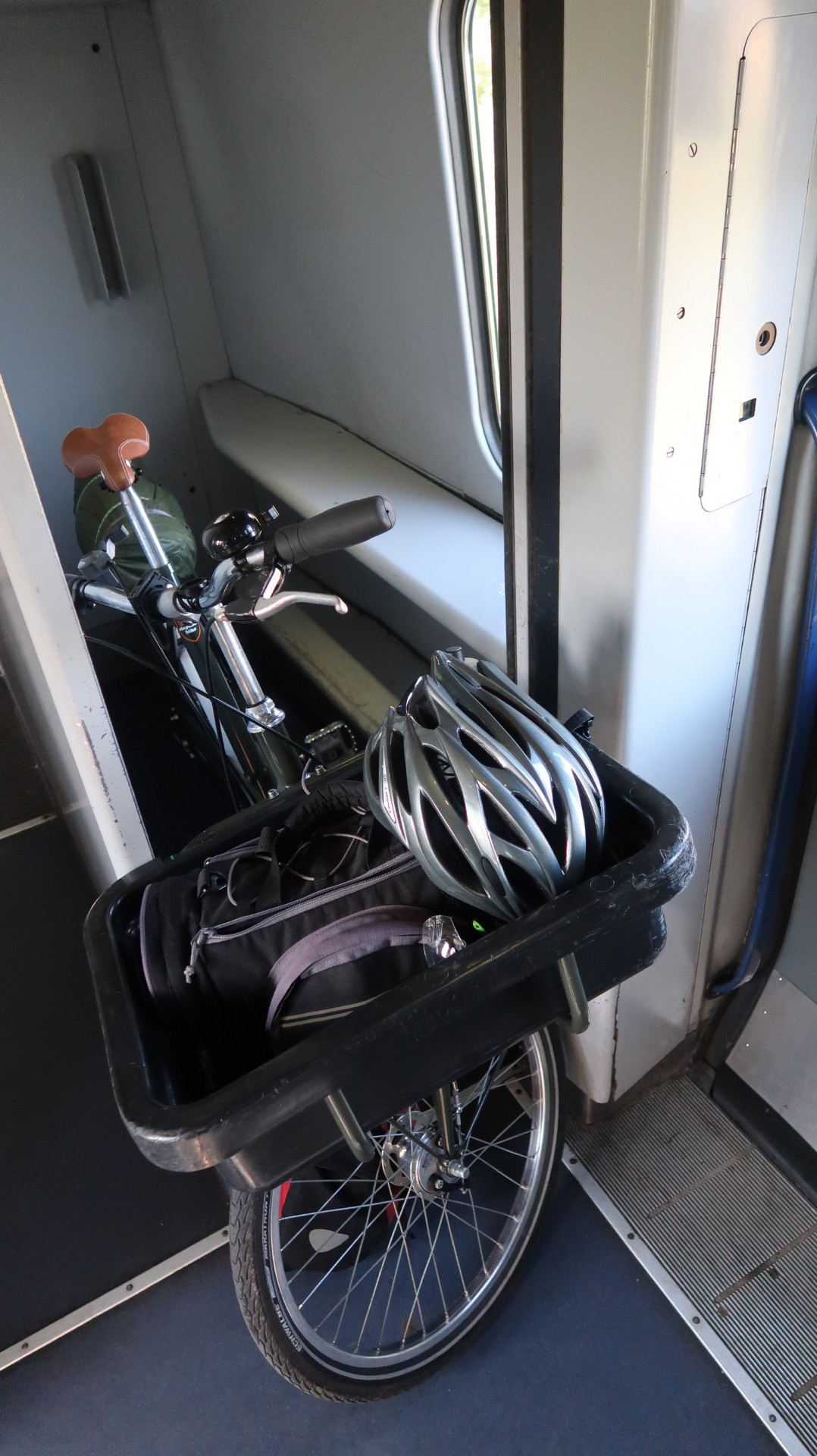
Spaces for cycles on trains vary widely, both in design and number, and across (and even within) operators. The most common number of spaces is two, sometimes three or four, and on some of the older intercity stock, a few more. Some consist simply of an open space where your bike rests as though leaning against a wall, others have hooks to which the bike has to be lifted to hang vertically (often in a cramped cubicle), and occasionally bikes are stowed in a separate compartment away from passengers. Each has its own challenges, but the stress often arises when you don’t know which of these circumstances you’re likely to face. Then when the train arrives, whether the space will be available (often even when you do have a reservation!), occupied by parents with children in pushchairs, filled with luggage, easily accessed when you’re rushing back and forth to the platform to bring on your bike and panniers. Or maybe the bike space is at the other end of the train from the carriage where your seat is reserved. And if you’re a family of four each of whom has their own bike, well good luck with that when the majority of trains only seem to have two spaces.
One feature which appears common across operators and is related to space, is that only certain types of bikes are allowed:
Please note: a ‘bike’ refers to an unpowered two-wheel cycle – it excludes tandems, tricycles, power-assisted cycles and trailers.
(Northern, but the other operators have similar statements)
So if you’re a couple who tours by tandem, a disabled cyclist who uses a trike, or a tourer with a trailer, you’re pretty much stuffed. The ‘power-assisted cycles’ also raises an interesting point, given how common e-bikes have now become and how important they seem to be in encouraging and enabling some people to cycle who might not otherwise have done. ScotRail deserves a bit of kudos here:
ScotRail welcome electric cycles (e-bikes) on our services’ but ‘Please note, to avoid damaging the on-train electrical circuits, ScotRail cannot allow e-bikes to be charged via the plug sockets on our trains.
ScotRail
Perhaps there’s a missed opportunity there. Imagine if you’re an e-biker stuck on a train for five hours, but you could charge your bike, perhaps paying a small fee for the privilege?
Based on accounts I’ve read, I can’t help feeling our European neighbours make much better provision for cyclists on trains. I’ve only travelled by train on the continent once in recent years, albeit not with a bike, and it was the Netherlands. Having flown in to Schipol, I didn’t have a bike with me, but on each of the trains I caught, there seemed to be so much space available for bikes, and it was easy to access. Perhaps that’s not always the case though:
Seat61 offers plenty of advice, including how to get to Europe, then on what different countries allow.
So in conclusion, and returning to the topic of of the original research request – ‘encouraging both cycle and train travel’ – what advice would I offer to a rail operator seeking to do this?
- Make it easy to obtain tickets and secure reservations for the bike for the whole journey.
- Create adequate, cycle-friendly spaces on trains across all fleets.
- Ensure bike storage is adequately marked on the outside of the carriage, and provide advance notice of where on the train the bike spaces are located.
The most challenging aspect of travelling by train with your bike is navigating the inconsistency of provision. You simply never know what to expect from the moment you try to buy a ticket to stepping off the train at the end of the journey … hopefully at the destination you were aiming for! Consistency then might be the holy grail.